Anatomy of a steam locomotive
4-6-2 PacificFire heats water in the boiler; steam pushes a piston back and forth in the cylinder; the piston turns the wheels through a rod. Everything else you can see is there to serve those three sentences.
A tank engine carries its water in tanks slung on the boiler and its coal in a bunker
behind the cab — compact, quick to turn round, ideal for shunting and short runs, and
modelled with a T suffix (0-6-0T). A tender engine tows its
supplies, so it can run much further between stops.
Reading wheel arrangements
Whyte notation counts wheels, front to back, in three groups: leading (unpowered), driving (powered), trailing (unpowered). A 4-6-2 has four leading wheels, six drivers, two trailing wheels.
Why it matters for models
More driving wheels means more pickup points and more pulling power, but a longer rigid wheelbase that hates tight curves. A 0-6-0 will go anywhere; a 4-8-4 wants 24 inch radius or better in HO.
Diesel and electric notation
Letters count powered axles per bogie: B-B is two bogies of two powered axles; C-C is two of three; A1A-A1A has an unpowered centre axle in each. British classes add the same suffixes — a Class 47 is a Co-Co.
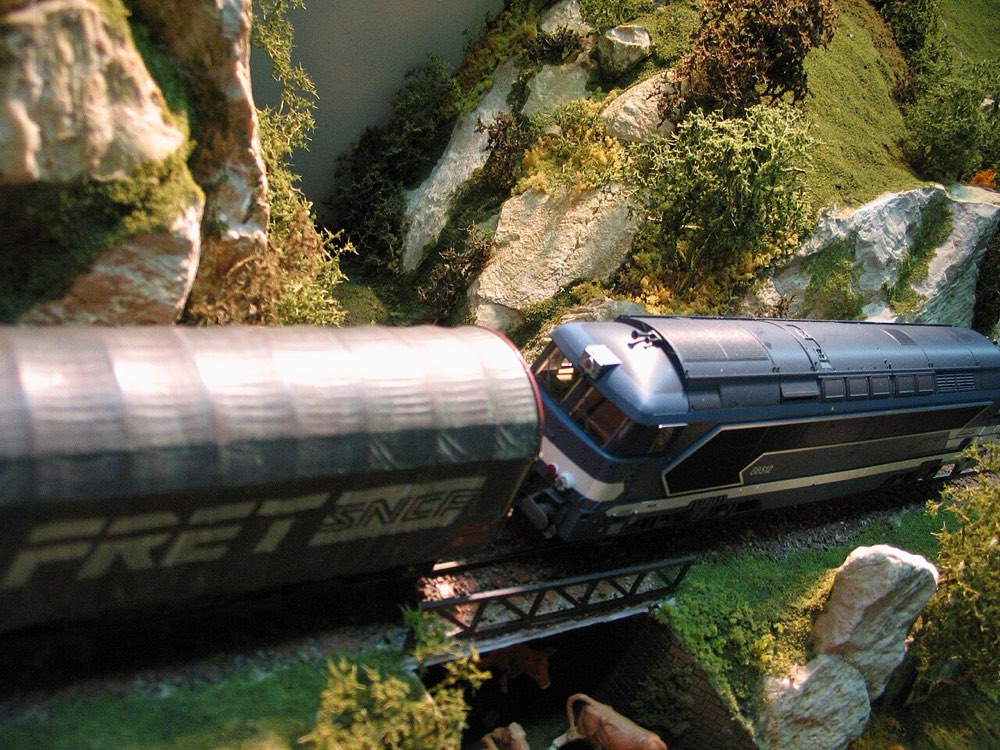
Anatomy of a diesel
it is really a power station on wheelsAlmost no mainline “diesel” drives its wheels through a gearbox. The engine turns a generator, the generator feeds electric motors mounted on the axles. It is a diesel-electric, and the model is doing exactly the same thing in miniature — minus the diesel.

What is inside the model
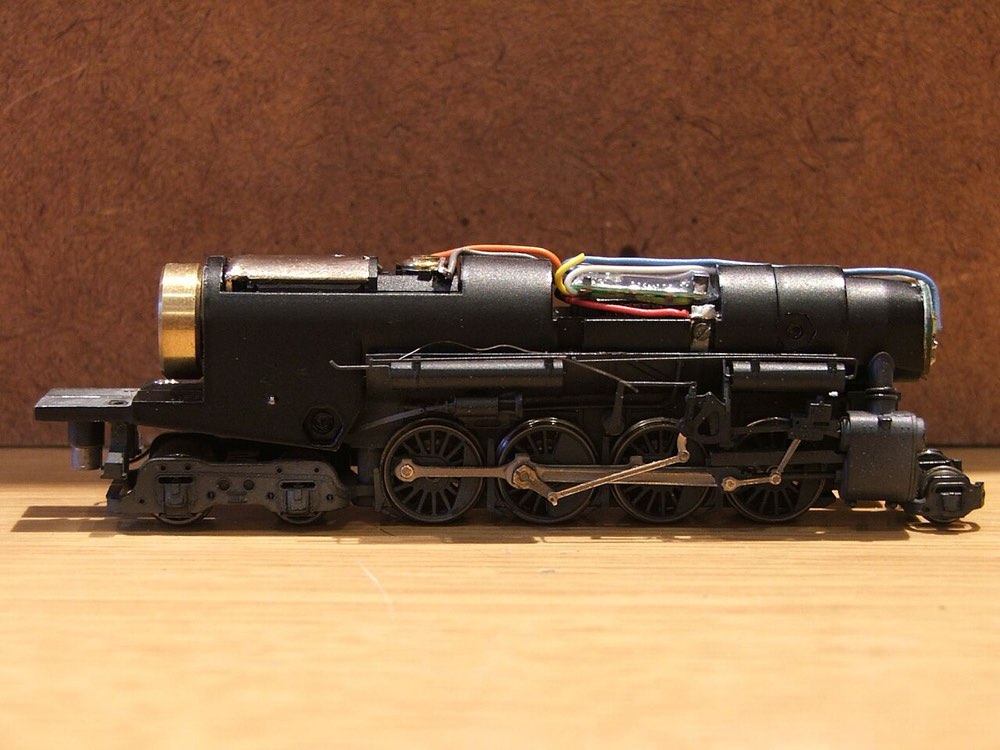
Steam or diesel, almost every modern model is the same six components. Learn them once.

Judging a model before you buy it
| Look for | Why |
|---|---|
| All-wheel pickup | Eight or twelve points of contact instead of four. The single biggest predictor of smooth slow running. Turn the model over: wipers or springs on every axle is what you want. |
| A flywheel (or two) | Momentum carries the mechanism across a dead frog or a dirty patch. Cheap models omit them. |
| A can motor with a worm and gear tower | Quiet, efficient, controllable. Open-frame motors with exposed brushes are 1970s technology and draw far more current. |
| Weight | Metal chassis, not plastic. Adhesion is weight on the driven axles — a heavy HO locomotive will pull twice what a light one will. |
| “DCC ready” vs “DCC fitted” | Ready means there is a socket (8-pin NEM652, 21MTC, or the 6-pin Next18) so you can plug a decoder in. Fitted means one is already installed. Neither means sound — check separately. |
| Free rolling | Push it along a length of track by hand. It should coast. Notchy or tight means a gear problem you will be fighting later. |
The rolling stock vocabulary
A pivoting four-wheel assembly under each end of a wagon is a bogie in Britain and a truck in North America. British four-wheel wagons have no bogies at all — the axles sit directly in the chassis, which is why they look so short and are such fun to shunt.
Couplers, and the one gauge that fixes everything
A Kadee coupler height gauge (or the equivalent for your standard) is a small metal casting that sits on the rails and shows, in one glance, whether a coupler is at the right height and whether its trip pin is too low. Every mystery uncoupling on a gradient and every “it derails at that one turnout” traces back to this. It costs less than a wagon.
Wheels and weight
Metal wheels instead of plastic: they stay clean (plastic accumulates a black gunge from the rails and then spreads it), they run quieter, and they lower the centre of gravity. Re-wheeling a fleet is the cheapest running-quality upgrade there is.
Weight matters more than anyone expects. A light wagon at the front of a train gets squeezed off the rails by the ones behind, especially through a turnout on a curve. The NMRA recommendation (RP-20.1) is a starting weight plus an allowance per inch of body length:
| Scale | Base | Per inch of length | A 50 ft boxcar works out at |
|---|---|---|---|
| N | 0.5 oz | +0.15 oz | ≈ 1.1 oz / 31 g |
| HO | 1 oz | +0.5 oz | ≈ 4.5 oz / 127 g |
| S | 2 oz | +0.5 oz | ≈ 6.7 oz / 190 g |
| O | 5 oz | +1 oz | ≈ 17.5 oz / 496 g |
Add the weight low and central — self-adhesive lead or steel strip inside the floor, or stick-on wheel weights from a tyre shop. British practice weights rather lighter; consistency across your fleet matters more than the exact figure.
Keeping it running
- Run new models in. Twenty minutes each way at half speed, no load. Gears bed in and stiff mechanisms free up.
- Clean the wheels, not just the track. A paper towel dampened with isopropyl alcohol laid on a powered section: hold the locomotive so one side's wheels spin on the towel. The black stripe that appears is your answer.
- Oil sparingly. One drop of light plastic-compatible oil on each axle bearing and the motor bushes, per year. Grease only on gears, and only a smear. Too much oil creeps onto the wheel treads and then onto your track.
- Never use an abrasive block on nickel silver rail. It leaves scratches that trap dirt faster. Isopropyl alcohol on a hardwood block, or a proper track-cleaning car.
- Keep a service log. A card per locomotive with the DCC address, decoder type and date last oiled saves an astonishing amount of guessing.